Citrons, Yuzu, & Papeda

For people who find lemons a little too normal.
Variety Characteristics
Citrons
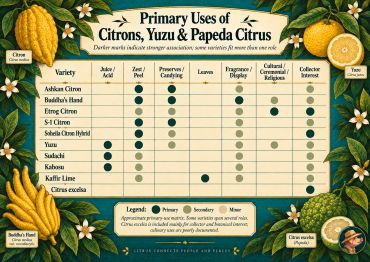
With citrons, the peel is often the harvest. Thick, fragrant rind can become candied peel, preserves, or zest, while the fruit itself may serve as a living ornament. This group ranges from the sculptural Buddha’s Hand to Etrog, with its long religious history, and less familiar selections for curious growers. True citrons are especially sensitive to frost, so a sheltered location matters.

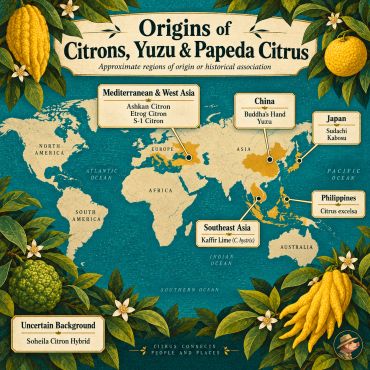
Buddha’s Hand has been carved in jade and given as a New Year’s gift in Japan, where it symbolizes good fortune. Its curling yellow fingers contain no juicy pulp or seeds: the harvest is fragrant peel and white pith. Use it for zest, preserves, or infusing drinks, or simply enjoy its floral perfume indoors. The small, shrubby tree is highly frost-sensitive and needs a protected spot.
Etrog’s story reaches far beyond the kitchen: citrons have been central to the Jewish festival of Sukkot for centuries. This Israeli selection has thick, fragrant rind with a violet-like aroma and relatively little juice. It offers a connection to that history, along with peel for culinary use. Grafted trees are not suitable sources of fruit for traditional religious observance. Protect this frost-sensitive citron from cold.
S-1 earned its place in citrus history as a disease detective. Selected from Arizona 861 citron, it proved especially sensitive to mild citrus viroids, making it useful for detecting infections in other citrus. Its fruit resembles Etrog; UCR tasters found floral rind and unexpectedly juicy, tart flesh with a little sweetness. A collector’s citron with a role in the science behind healthy citrus trees.
Ashkan is a citron for growers who enjoy making their own observations. It entered California’s clean budwood program from a California source as VI 984, but its earlier history and distinctive fruit qualities remain poorly documented. For a collector, it offers an unfamiliar selection to compare with better-known citrons; its flavor and garden performance still need a fuller record.
Soheila entered UCR’s collection from Paradise Nursery in Chatsworth with little information about its ancestry. Once it fruited, researchers recognized a citron hybrid: large yellow fruit, a pebbly rind with citron-like fragrance, and sour, slightly bitter flesh. Its unresolved pedigree makes it an intriguing comparison for a citron collection, though it should not be mistaken for a sweet, fresh-eating fruit.
Images used with permission from UC-Riverside Citrus Variety Collection. Do not copy or reproduce.
Yuzu & Papeda
A few leaves, a strip of zest, or a squeeze of juice can be the whole harvest’s purpose. Yuzu, sudachi, kabosu, and makrut lime bring distinctive aromas to Asian cooking, while less familiar relatives appeal to citrus collectors. These are mostly seasoning fruits rather than sweet snacks. Their growing needs differ, so yuzu’s reputation for cold hardiness should not be applied to the entire group.
UCR’s yuzu traces to seed collected by plant explorer Frank Meyer in China’s Hubei mountains in 1917, although the fruit is now closely associated with Japanese cooking. Its fragrant peel and sharp juice flavor ponzu, preserves, and drinks. The fruit is packed with seeds, so a little harvest goes toward seasoning rather than a glass of juice. A thorny tree with unusual cold hardiness for citrus.
The leaves are the main reason to grow this citrus. Also called makrut lime, it supplies the pungent fragrance familiar in Thai and Indonesian cooking. Each leaf looks like two joined together because its winged stalk is almost as broad as the blade. The knobbly fruit is very sour and slightly bitter, but a backyard tree can provide fresh aromatic leaves without waiting for a fruit harvest.
Kabosu is closely tied to Japan’s Oita Prefecture, where its green fruit is squeezed over fish and used in soups and sauces. UCR’s comparisons found it less acidic than yuzu or sudachi, though still firmly a sour seasoning fruit. It also earns its space as an ornamental: mature trial trees on citrange rootstocks formed dense, spreading canopies about 10 feet tall. Harvest green for its traditional culinary use.
Sudachi arose as a chance seedling in Japan’s Tokushima Prefecture and became a local culinary signature. Its small green fruits are cut into wedges for fish or used to flavor vinegars and drinks. The fragrance is distinct from yuzu, giving cooks a reason to grow both. Harvest while green for cooking; UCR records that stage in September–October at Riverside, when the fruits average only about 1½ inches across.
Citrus excelsa arrived at UCR from the Philippines in 1930, and even its place in the citrus family has puzzled researchers. Also recorded as Le Nestour and Limon Real, it produces seedy, very sour fruit with thin rind and coarse pulp. Its documented role includes detecting citrus tatter leaf disease. Best approached as a botanical collector’s tree, with limited evidence of culinary value.
Images used with permission from UC-Riverside Citrus Variety Collection. Do not copy or reproduce.