Grapefruit

Enjoy my grapefruit charts. Then, enjoy a grapefruit.
Variety Characteristics

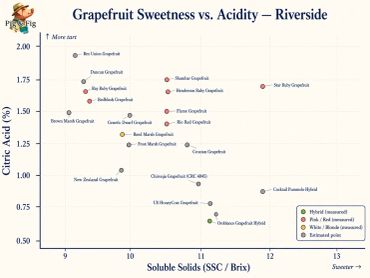
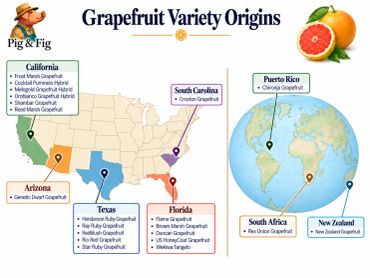
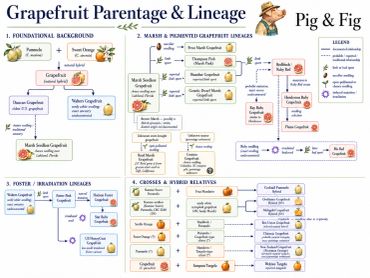
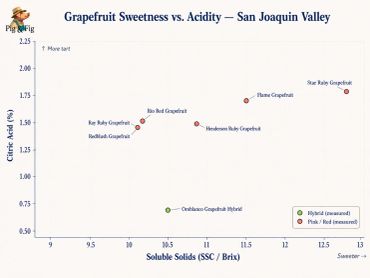
Grapefruit Hybrids
Grapefruit relatives with a range of flavors, from mild and sweet to pleasantly tart. This group includes grapefruit crosses and other citrus hybrids commonly grown as grapefruit alternatives. Some ripen with less summer heat than traditional grapefruit, but climate suitability varies. Explore each variety for differences in flavor, seediness, size, and harvest season.

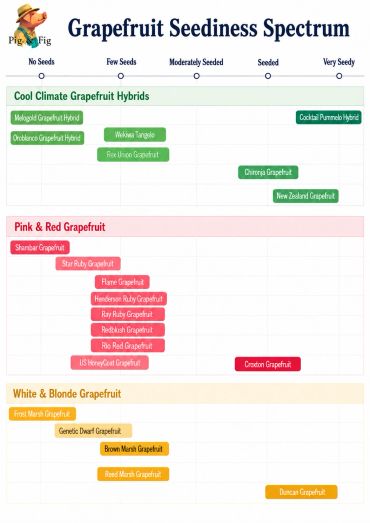
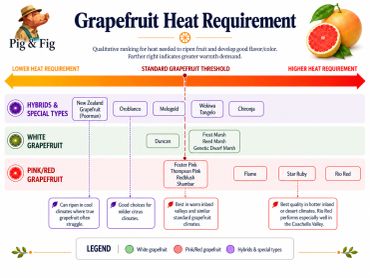
Oroblanco is a pummelo–grapefruit hybrid developed at UCR. Its large, nearly seedless fruit is unusually sweet and mild, with low acidity and much less bitterness than standard grapefruit. It also needs less heat to develop good quality, making it especially useful in cooler coastal and mild inland parts of California where conventional grapefruit may disappoint.
Cocktail “Grapefruit” is not actually a grapefruit, but a UC Riverside hybrid of Siamese Sweet pummelo and Frua mandarin. It was never formally released by UCR, but escaped from the breeding program and became popular with California home growers and farmers-market producers and is often labeled as a grapefruit by nurseries. The unusual fruit combines the sweetness of a low-acid pummelo with the flavor and juiciness of a mandarin.
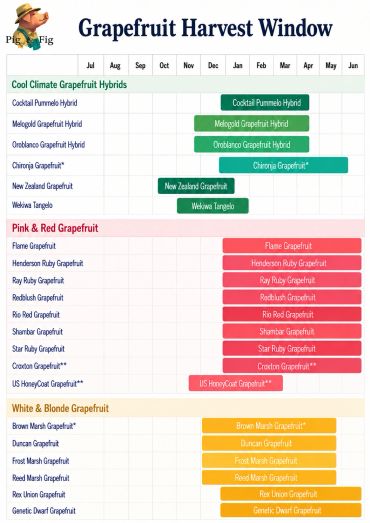
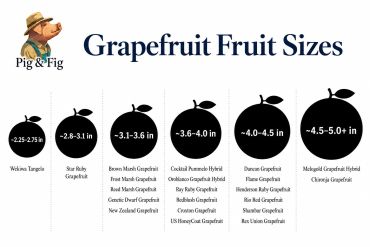
Melogold is a UC Riverside pummelo–grapefruit hybrid with larger, more pummelo-like fruit than its sibling Oroblanco. The pale flesh is juicy, nearly seedless, and sweet with low acidity; the substantial rind and membranes are best removed before eating. It ripens earlier than conventional grapefruit, but cool coastal conditions can produce disappointing flavor. Best suited to mild inland citrus gardens, with room for a large tree.
Chironja is an unusual Puerto Rican citrus traditionally regarded as a natural sweet orange–grapefruit hybrid, though its exact parentage remains uncertain. The fruit is large, juicy, and notably sweeter and less bitter than typical grapefruit, with a flavor that leans strongly toward orange. Its obscure Caribbean origin and distinctive taste make it especially appealing to collectors.
New Zealand Grapefruit, also called Poorman Orange, is not a true grapefruit but an old pummelo-type hybrid that became the standard “grapefruit” of New Zealand because it can ripen where true grapefruit lacks enough heat. The fruit is juicy, sweet-tart, and mildly bitter, with orange-yellow flesh and numerous seeds. Its cool-climate adaptability makes it especially interesting for California growers near the coast.

Wekiwa is an unusual historic “tangelolo,” a grapefruit × Sampson tangelo hybrid—making it roughly three-quarters grapefruit by pedigree. Its small, juicy fruit is sweet and mildly tart, with pale yellow rind that can develop a pink blush and amber-pink flesh under favorable conditions. Early ripening from November to January at Riverside, it is a distinctive collector’s grapefruit hybrid rather than a typical tangelo.
Santa Barbara has a distinctly grapefruit-like character: juicy fruit with large segments, few seeds, and pink coloring near the rind. The yellow skin can show reddish oil glands. At roughly 2½ inches across, the fruit is smaller than a typical grapefruit, and its October–November season at Riverside is early. Its parentage is unknown.
Images used with permission from UC-Riverside Citrus Variety Collection. Do not copy or reproduce.
Pink & Red Grapefruit
Pink and red grapefruit range from the early blush-colored selections that transformed the grapefruit industry to modern cultivars bred for deeper color, fewer seeds, and improved fruit quality. Most are true grapefruit and develop their best sweetness and flavor in warm inland climates. Flesh color varies from pale pink to deep ruby-red, but color alone does not indicate sweetness—each variety has its own balance of sugar, acidity, bitterness, and harvest season.
Flame is a Florida grapefruit bred for deep red color without the fussiness of Star Ruby. Its flesh can approach Star Ruby in intensity, but the tree is more vigorous and better able to handle cold. For home growers who want a striking red grapefruit with fewer cultural headaches, Flame offers an unusually good balance of appearance, performance, and eating quality.
Rio Red is the standard red grapefruit of the Texas industry, bred at the Texas A&M Citrus Center from irradiated budwood and released in 1984. Its deep red, nearly seedless flesh holds color far better than the older Ruby Red types, and fruit keeps sweetening on the tree from winter into spring. Rio Red is a true grapefruit with a high heat requirement — expect excellent fruit in the Central Valley and hot inland yards, but thin, tart fruit near the coast.
Redblush, also known as Ruby Red, is the grapefruit that brought deep pink-red flesh into the mainstream. Discovered in Texas as a mutation of Thompson, it became one of the foundational red grapefruit cultivars and helped set the direction for the deeper-red varieties that followed. For a home grower, its appeal is historical as much as horticultural: this is one of the varieties that changed what people expect a grapefruit to look like.
Shambar is California's own grapefruit — a bud sport of Marsh found in a Corona orchard in 1936 and sold commercially from 1945, but never widely planted. The fruit is seedless, with attractive salmon-colored flesh and typical pigmented grapefruit flavor, and may ripen slightly ahead of Marsh. Its reputation for deeper color is shaky: UCR evaluators at Lindcove found it essentially identical to Redblush. Like any true grapefruit, it needs hot inland summers to sweeten.
Star Ruby came out of R. A. Hensz's Texas breeding program from irradiated Hudson grapefruit seed, and it still has the darkest flesh of any pigmented grapefruit — deep red, juicy and nearly seedless under a smooth, blushed rind. It is also the fussiest: less vigorous than other grapefruit, with smaller fruit and more trouble from phytophthora, nutrient deficiencies, cold and pests. Not a beginner's grapefruit, but nothing else comes close on color.
Henderson Ruby is a Texas grapefruit discovered in the early 1970s as a limb mutation of an older red grapefruit tree. It was an important step beyond Ruby Red, producing much deeper red flesh and stronger rind blush while holding its color later into the season. The fruit is commercially seedless and of excellent eating quality, making it an appealing choice for growers who want a classic Texas-style red grapefruit.
Croxton is a rare South Carolina grapefruit grown from seed by Richard Croxton in Columbia and later preserved and promoted by longtime citrus collector Hershell, who has called it his favorite grapefruit. The original tree became known for thriving well outside the usual grapefruit belt. Its backyard origin, Southern hardiness, and endorsement by an experienced collector give Croxton an unusually compelling story.
Ray Ruby is a Texas red grapefruit discovered as a natural mutation in Weslaco in 1970. Its appeal is classic Rio Grande Valley grapefruit character: richly colored flesh, strong sweet-tart flavor, and best quality in substantial summer heat. For growers in hot inland California, it offers a distinctly Texas-style red grapefruit that rewards the right climate.
US HoneyCoat began in 1973 when USDA breeder C.J. Hearn irradiated Foster grapefruit, then spent decades moving through selection and regeneration before its 2018 release. The result is a pink grapefruit that keeps classic grapefruit character but with far fewer seeds, lower acidity and bitterness, and earlier maturity. Its long path from mutation experiment to named cultivar makes it one of the more unusual modern USDA grapefruits.
Images used with permission from UC-Riverside Citrus Variety Collection. Do not copy or reproduce.
White & Blonde Grapefruit
White and blonde grapefruit represent the classic grapefruit tradition, with pale yellow flesh and the bright, aromatic, sweet-tart flavor that defined the fruit before red varieties became dominant. This group includes historic cultivars such as Duncan and Marsh, along with later selections and unusual forms. They vary widely in seediness and flavor, but most perform best where summer heat is sufficient to reduce acidity and develop their characteristic richness.
Duncan is one of the oldest named grapefruit cultivars in America, tracing to a tree growing near Safety Harbor, Florida by about 1830. Long before seedless grapefruit took over the market, Duncan was prized for its rich, intense flavor and became a benchmark for grapefruit quality. It is very seedy, but for collectors its historical importance, vigorous growth, and reputation for unusual cold toughness make it a true heritage variety.
The classic nearly seedless white grapefruit, with pale yellow flesh, abundant juice, and a tart flavor that mellows as it ripens. Marsh needs plenty of summer heat for good eating quality; fruit matures late and holds well on the tree. Expect vigorous growth and a large, spreading canopy. Frost is a nucellar selection—a natural clone of its Marsh seed parent—preserving the familiar variety.
Genetic Dwarf Grapefruit is a limb sport of Marsh discovered in Yuma, Arizona and brought to UC Riverside in the 1960s. The name is misleading: “dwarf” refers mainly to its shorter internodes, smaller leaves, and denser growth, not to a truly dwarf tree. It can still approach normal grapefruit size at maturity, so buyers should expect a somewhat more compact Marsh—not a patio-sized tree.
Images used with permission from UC-Riverside Citrus Variety Collection. Do not copy or reproduce.