Kumquats

Bite sized citrus.
Variety Characteristics
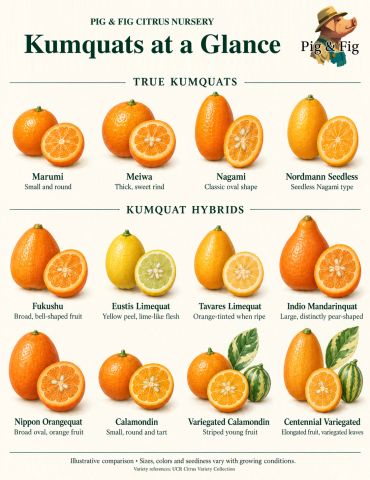
True Kumquats
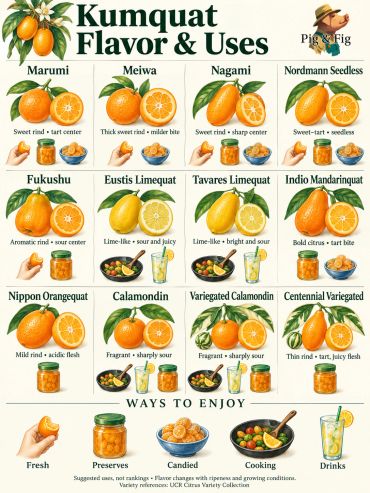
The classic kumquat types, selected primarily from the traditional Nagami, Marumi and Meiwa lines. These are the fruits that define the group: small, cold-hardy citrus with edible, aromatic rinds and flesh ranging from sharply tart to pleasantly sweet. Some have complicated ancestry, but they remain horticulturally recognizable as kumquats rather than crosses with other citrus.

Marumi is the classic round kumquat: small, golden fruit with a thin, aromatic rind and sharply acidic interior. Unlike the oval Nagami, its fruit is nearly spherical and the tree may carry a few small thorns. This accession came to UCR from INRA’s Corsican citrus collection in 2003; the earlier history of the selection is unknown.
Meiwa sits at the sweeter end of the kumquat spectrum. The fruit is round to short-oblong, with an unusually thick, sweet rind that makes the whole fruit taste sweeter than Nagami; seed count is often low. Swingle eventually regarded Meiwa as a natural hybrid between the round and oval kumquats. It is one of the best traditional kumquats for eating fresh.
The benchmark kumquat and still the most widely grown. Nagami makes oval, deep-orange fruit meant to be eaten whole: the rind is sweet and aromatic while the flesh is distinctly tart, creating the classic kumquat contrast. The dense tree becomes semi-dormant in winter, one reason kumquats tolerate cold better than many citrus. Expect several seeds per fruit.
Nordmann Seedless began with a Nagami seedling planted in DeLand, Florida, in 1965. George Nordmann noticed that one seedling produced seedless fruit and preserved it by budding before the original tree later froze. Fruit is much like Nagami—sweet rind, tart flesh and heavy crops, but essentially seedless. A genuinely useful improvement on the familiar type.
Images used with permission from UC-Riverside Citrus Variety Collection. Do not copy or reproduce.
Kumquat Hybrids
Kumquats cross surprisingly well with other citrus—and sometimes with one another. This group includes limequats, orangequats, calamondins and other selections that combine kumquat traits such as edible peel, compact growth or cold tolerance with characteristics inherited from limes, mandarins and related citrus. Their flavors, fruit sizes and appearances are correspondingly diverse.
Known as Calamansi in the Philippines, Calamondin is probably a natural hybrid with kumquat in its ancestry, although its exact parents remain uncertain. The tiny orange fruit has a thin edible rind and intensely acidic, juicy flesh, making it far more useful in the kitchen than its ornamental reputation suggests. Dense foliage and repeated flowering can keep fruit on the tree much of the year.
Also called Changshou, Fukushu is a large-fruited kumquat type probably derived from a chance cross between kumquat species. Its broad, often bell-shaped fruit has a relatively thin orange rind and tart flesh. The small, thornless, spreading tree has unusually broad leaves and has long been grown as a potted citrus in China and Japan.
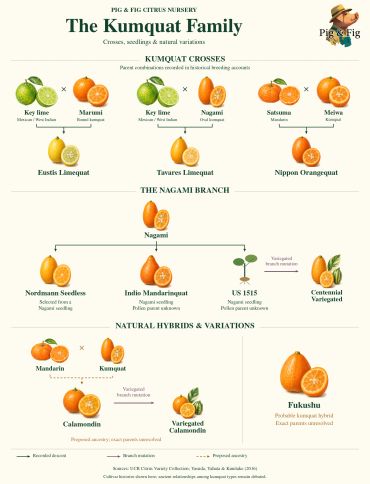
One of Walter Swingle’s original 1909 limequats, Eustis crosses West Indian (Key) lime with round kumquat. The fruit resembles a small lime, with a thin edible rind and very acidic, lime-like pulp. It was bred to carry useful lime character into a more cold-resistant plant; it is hardier than Key lime, but not nearly as hardy as a true kumquat.
Indio is a collector’s citrus with a slightly murky pedigree. UCR records trace it to an open-pollinated Nagami seedling; the pollen parent is unknown despite the “mandarinquat” name. Its fruit is much larger than a typical kumquat, orange and distinctly necked, with tart juice and an edible rind. It is best understood as an unusual Nagami-derived hybrid, not a miniature mandarin.
Reported as a Satsuma mandarin × Meiwa kumquat hybrid, Nippon looks promising on paper but is not a sweet little orange. Fruit is larger than a kumquat, orange, juicy and usually few-seeded; the rind is relatively thick while the pulp stays decidedly acidic. It has long been regarded more as an ornamental and marmalade fruit than a fresh-eating favorite.
Developed by Walter Swingle in Florida in 1909, Tavares pairs West Indian lime with oval/Nagami kumquat. It differs visibly from Eustis: mature fruit takes on more orange coloration, and the flower buds can show the pink inherited from the lime parent. The fruit remains lime-like—juicy and sharply acidic—but the plant is more cold-resistant than West Indian lime.
Variegated Calamondin arose as a branch mutation of ordinary calamondin and reached UCR from Paul Peters of Altadena in 1954. Leaves are marbled cream and green; young fruit is striped, though the pattern fades as it ripens orange. Beneath the ornamentation it behaves like calamondin: compact, productive, repeatedly flowering, with small, juicy, strongly acidic fruit.
Centennial began as a variegated twig found in 1986 on USDA selection US 1515, itself an open-pollinated Nagami seedling. Released by USDA in 1993, it has green, cream and yellow foliage and striped young fruit that turns orange at maturity. The fruit is rounder and juicier, with a thinner peel than Nagami and few seeds. Its unknown pollen parent makes hybrid classification the safer choice.
Images used with permission from UC-Riverside Citrus Variety Collection. Do not copy or reproduce.